See what an evidence-led workforce review looks like before you engage us.
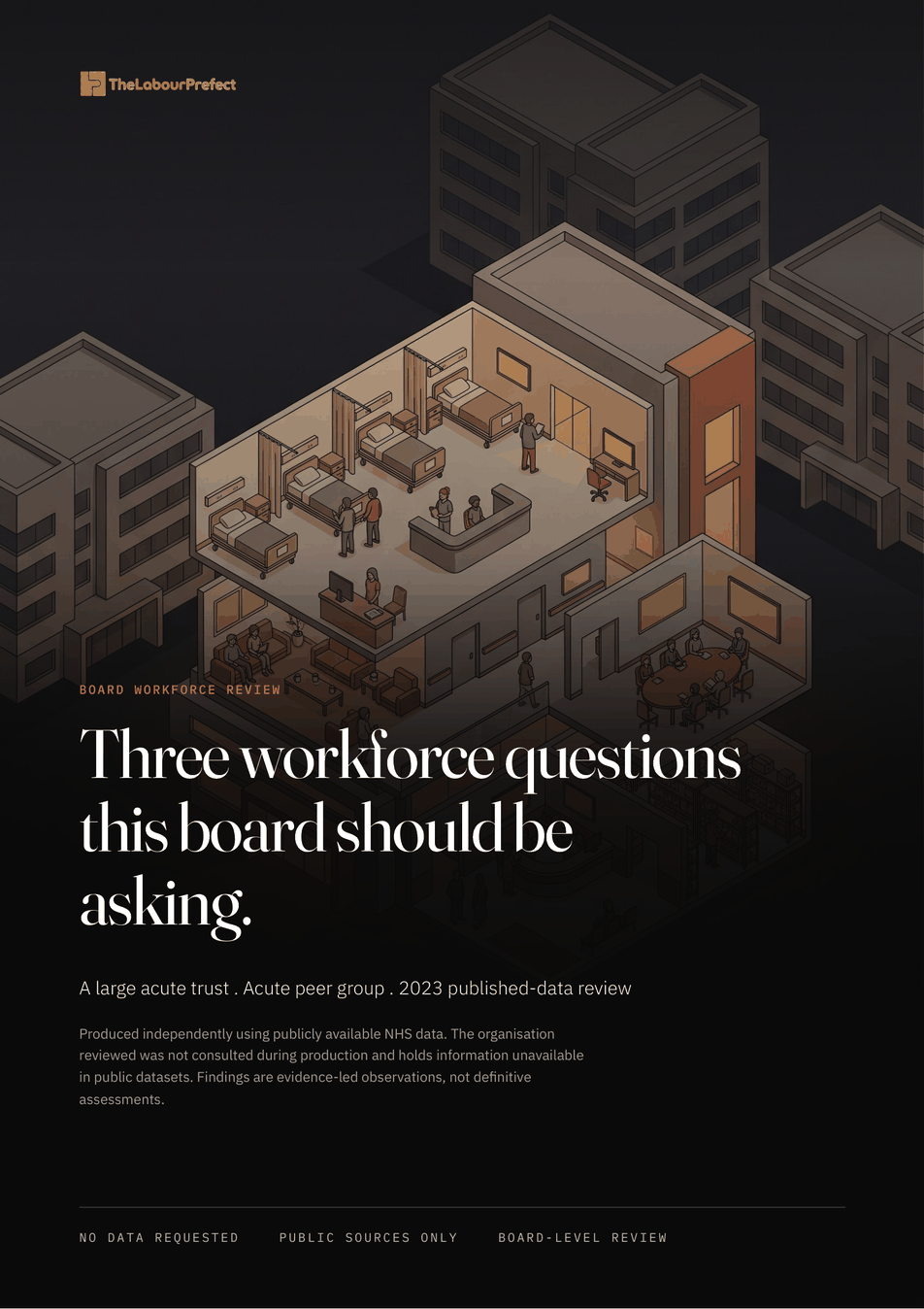
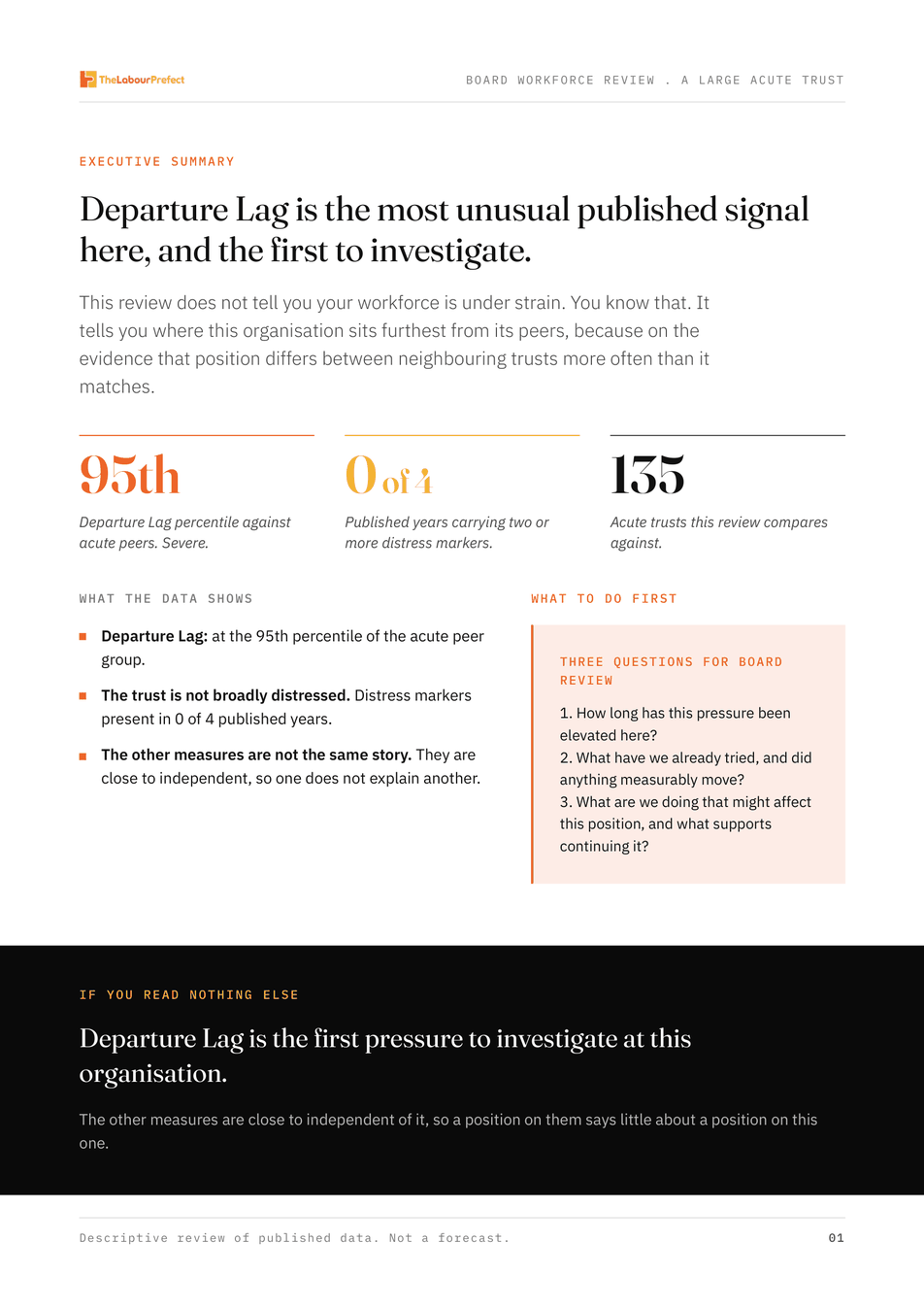
A complete, anonymised structural review of a large acute trust. Built entirely from published data, with no engagement or commission from the trust, and no internal data request of any kind. It is the actual deliverable, not a brochure about the deliverable.
WE ASK FOR AN EMAIL SO WE KNOW WHO IS READING. YOU GET THE REPORT ON THE NEXT SCREEN, NOT IN AN INBOX. NO SEQUENCE, NO CALL UNLESS YOU BOOK ONE. HOW WE HANDLE IT.
What is in it
This is the report’s own contents page, reproduced. If the document you receive does not match it, we have mis-described it and we want to know.
| Section | What it contains | |
|---|---|---|
| 01 | What the watch list corresponds to outside this company | Whether the watch-list rule matches CQC and NHS England judgements. |
| 01B | What that evidence does not establish | The limits of that validation, next to the result itself. |
| 02 | Where this organisation sits | Position on the two published measures against 135 acute peers. |
| 03 | What Departure Lag actually describes | What the most elevated measure is, and is not, measuring here. |
| 04 | The measures do not agree with each other, and that is the point | Why three separate axes, and why no blended score exists. |
| 04B | A severe reading and a clean watch-list record are not a contradiction | How a high percentile and a clean record sit together. |
| 05 | Four things worth stopping before anything is started | The do-not-do list, specific to this position. |
| 06 | What was observed after agency share fell | The absence relationship observed in the six months after agency share fell. |
| 06B | Why that figure is not a cost, and not a saving | What the pounds value, and what they do not. |
| 07 | One thing you can test against your own data in 30 days | A hypothesis to check against data we were never given. |
| 08 | Three topics for board discussion | The questions this position puts on the agenda. |
| 09 | Seeing the independence rather than being told about it | The scatter behind the near-independence claim. |
| 10 | What would show that we are wrong | What could still overturn the findings here. |
| 11 | Method, and the limits that apply | What this analysis cannot see, and why. |
| A | Data sources and how each measure is built | Every figure traced to a named public source. |
| B | Terms of use, sources and challenge | Licence, sources, and how this draft was challenged. |
| C | Every technical term in this document, in plain English | The sixteen terms used here, defined. |
What it is not
It is not a forecast. There is no prediction of this trust’s future workforce position anywhere in the document, because we do not make them.
It is not a ranking. We do not publish league tables. The peer comparison exists to give the trust’s own position meaning, not to place it above or below anyone.
It is not a sales document with a diagnosis attached. Sections 10 and 11 are the limitations: what could still overturn the findings, and what the analysis could not see. They are in every report we write.
Why we give it away
Because the obvious objection is a reasonable one: how do you know this is any good until you have paid for it. Reading the whole thing is the fastest way to find out. If it is not the standard your board expects, you have lost the time it took to read it and we have not wasted your procurement process.
tests, every result recorded
failures, kept in the record
trusts in the benchmark
Read it first. Decide afterwards.
If it raises a question about your own organisation, that question is the agenda for a call. If it does not, you have an example of what independent workforce evidence looks like and you owe us nothing.